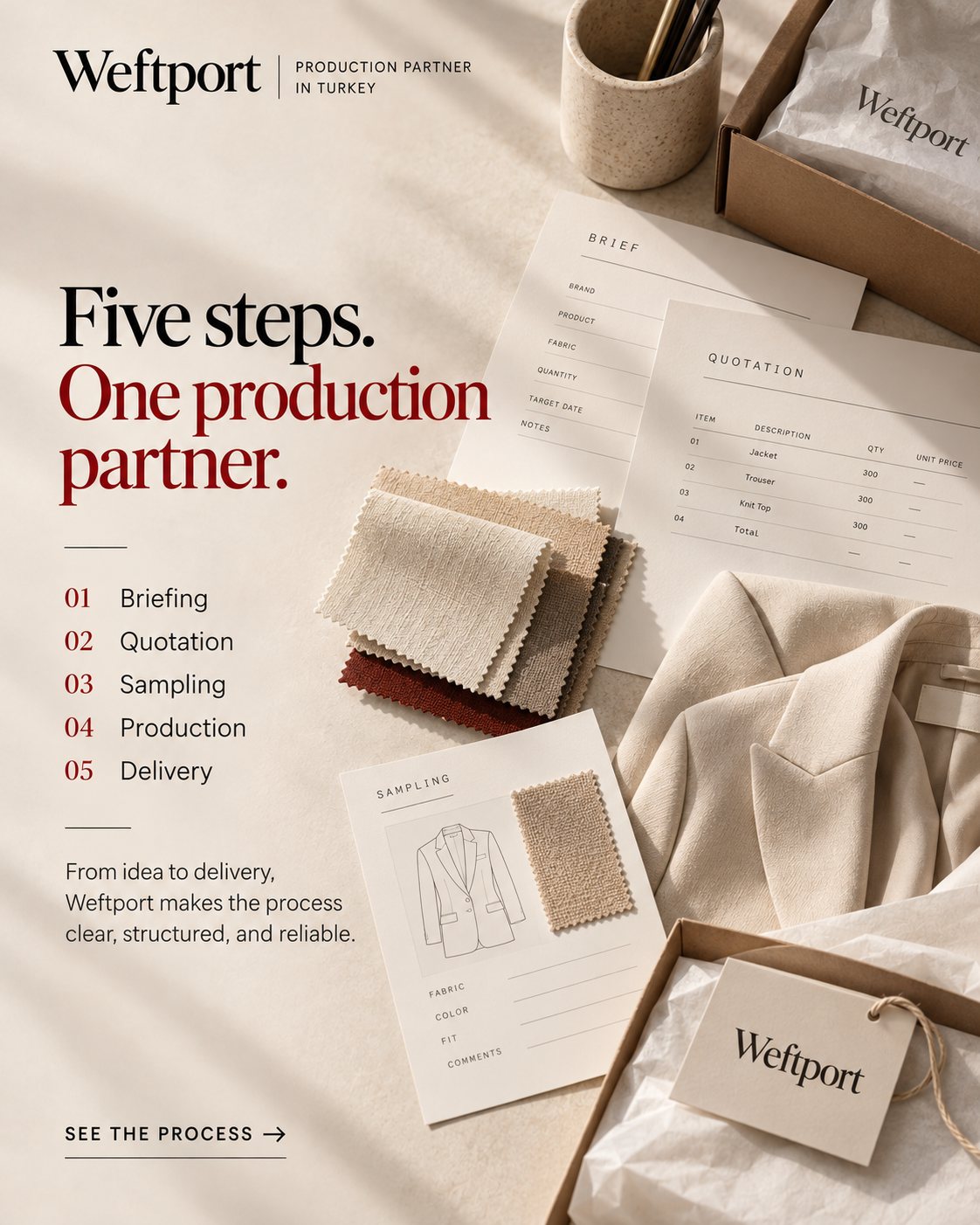
A clear process is the best protection against surprises. When both sides know what happens next, who decides and what is needed, a production project runs more smoothly. Weftport organises custom clothing production in five steps: briefing, quotation, sample, production and delivery. This article explains each step and what you can do to make it efficient.
Step 1: Briefing
The briefing defines the project. You share your design, ideally as a tech pack, together with the product category, estimated quantity, target market, fabric direction and your timeframe. If you only have a sketch and a reference garment, that is enough to begin, and we will come back with questions.
Your role: provide as much clarity as you can, and tell us what is fixed and what is flexible. Our tech pack checklist helps you prepare.
Step 2: Quotation
The factory calculates your style from fabric, construction, trims and quantity. A good quotation states what it assumes, so you can compare it fairly with others. Projects start from 500 pieces and there is no upper limit.
Your role: review the assumptions, ask about anything unclear and tell us if the target price needs a conversation about fabric or construction alternatives.
Step 3: Sample
The sample turns the drawing into a garment. You review fit, fabric, construction and details, and send back consolidated feedback. Complex styles may take more than one round. Our article on the first sample explains how to review it.
Your role: give clear, numbered, ranked feedback and approve the reference sample in writing.
Step 4: Production
After approval the order moves into production at our partner factory in Istanbul. Incoming fabric is inspected, and defective fabric is set aside before cutting. Production then runs through cutting, sewing, ironing, quality control and packing. Checks happen along the way, not only at the end.
Your role: keep the approved sample as the reference, route any change through one decision-maker and agree how you want progress information.
Step 5: Delivery
Finished goods are packed according to your instructions and shipped to your destination. Packing details such as folding, hangtags and carton marking should be agreed before production, not after.
Your role: compare the delivery with the approved sample, note feedback for the next order and confirm any follow-up needs.
Why a defined process helps
A defined process creates checkpoints: the brief, the quotation, the approved sample and the packing agreement. Each checkpoint is a record you can point to if there is a question later. It also keeps the conversation focused, because everyone knows which step the project is in.
Where projects usually lose time
Time is lost when a step is rushed or skipped. An incomplete brief causes extra quotation rounds. A rushed sample leads to corrections after cutting. An unclear packing agreement causes delays at the end. Preparing more at the start usually saves more later.
Who does what
You provide the design, the specification and the decisions. The factory provides development, production and inspection. Weftport coordinates the communication in English or German so questions are answered clearly and the process stays on track.
Questions people ask at each step
During the briefing, the most common question is how much detail is needed; the answer is enough to remove guesswork on fit, fabric and trims. During quotation, buyers ask what changes the price: fabric, construction complexity, trims and quantity are the main drivers. During sampling, they ask how many rounds to expect, which depends on the complexity of the style. In production, the question is how changes are handled, and the answer is that every change after approval is agreed and recorded. At delivery, the question is what happens next: usually a short review and, if the product works, a repeat order built on the proven specification.
Keeping the whole project in one place
Keep one shared folder with the tech pack, approved swatches, measurement lists, sample feedback and packing instructions. When everything lives in one place, new team members can pick up the project quickly and nothing depends on one person's memory. Name files with the style and a version number so it is always clear which one is current.
A simple way to start
Write down your category, estimated quantity, target market and what you have ready, whether that is a tech pack, sketches or a reference garment. Send it through the contact page, or read the process page for an overview first.
FAQ
What are the five steps?
Briefing, quotation, sample, production and delivery.
Do I need a tech pack to begin?
No. Sketches, a reference garment, measurements and a fabric direction are enough to start, though a tech pack makes everything more precise.
Who communicates with the factory?
Weftport coordinates communication in English or German.